

Scratches can be a minor irritation or an incredibly frustrating, painful, recurring skin condition. Here’s what we know about equine pastern dermatitis, what treatment actually involves and what more than a decade of managing a severe chronic case taught me.
If you’ve owned horses long enough, there’s a good chance you’ve encountered scratches.
Maybe you noticed a little redness behind the pastern. A few flakes. A crusty spot that wasn’t there yesterday.
Or maybe you’ve dealt with the other version: painful, cracked and weeping skin that refuses to heal no matter how diligently you clean it, dry it and work your way through seemingly every tub of ointment in the tack room.
I’ve dealt with both.
As a professional groom in South Florida, I’ve cared for dozens of horses and saw plenty of relatively ordinary cases of scratches. But my own horse, Simon, has dealt with severe recurrent pastern dermatitis for more than a decade.
His case has involved broken skin, thick crusting, heat, pain, swelling, occasional lameness and multiple bouts of cellulitis. Over the years we’ve tried everything from chlorhexidine and zinc oxide to prescription topical medications, systemic antibiotics and steroids, silver-impregnated socks, regenerative treatment and even an experimental placental patch therapy.
The biggest lesson?
“Scratches” isn’t really a diagnosis.
And when a case isn’t responding to the usual advice, endlessly repeating the same treatment may not be the answer.
What are scratches in horses?
“Scratches” is one of several common names for equine pastern dermatitis (EPD). You may also hear it called mud fever, mud rash, greasy heel, cracked heels or dew poisoning.
Rather than describing one particular infection, equine pastern dermatitis describes inflammation affecting the skin of the lower leg, most characteristically the pastern.
Veterinary literature considers EPD a syndrome or reaction pattern rather than a single disease. Different horses can therefore have very similar looking pastern lesions for different reasons.
There isn’t necessarily one organism hiding under the scabs that simply needs to be killed.
Environmental irritation, prolonged moisture, damaged skin, bacterial imbalance or secondary infection, parasites such as Chorioptes mites, contact irritation, immune-mediated disease and other dermatologic conditions can all enter the picture. UC Davis also lists allergies, drug reactions, fungi and sunlight-associated vascular disease among potential causes or differentials that veterinarians may need to consider.
In other words, two horses with what looks like “scratches” may not necessarily need identical treatment.
What do scratches look like?
One reason scratches are worth catching early is that they can look remarkably unimpressive at first.
In the earliest stages, I’ve often noticed:
- slightly pink or red skin
- flaky or scaly skin
- small crusts
- a thin crack or line beginning to form in the skin
- mild warmth
- sensitivity when handling the pastern
As inflammation progresses, horses can develop more obvious crusting, oozing, erosions or ulceration, swelling and painful skin. Some horses become lame. Chronic cases can eventually develop thickened and otherwise altered skin. Those changes are consistent with the clinical progression described by veterinary sources.

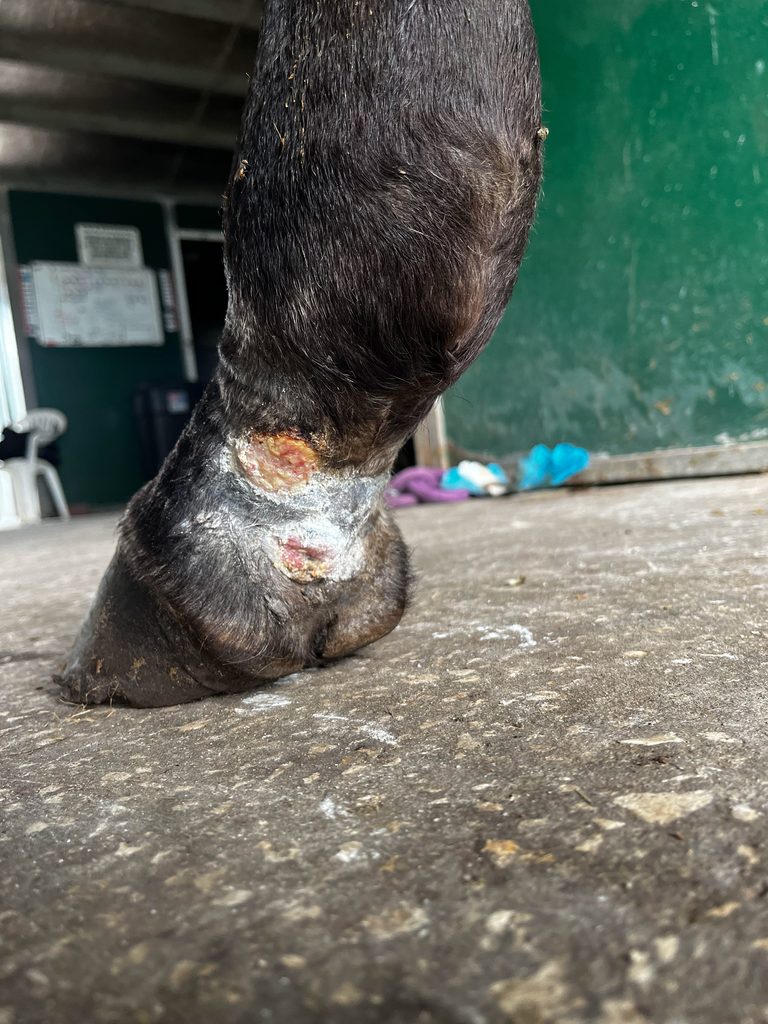
It’s worth getting familiar with what your individual horse’s healthy pasterns look and feel like. Catching a little irritated patch is much easier than discovering it after the entire back of the pastern is raw.
What causes scratches?
This is where scratches get complicated.
Moisture gets blamed for nearly everything—and with good reason. Wet bedding, mud and prolonged dampness are commonly associated with pastern dermatitis and reducing repeated moisture exposure is a standard management recommendation.
In my experience in South Florida, wet conditions were also one of the most consistent triggers. Morning dew, wet paddocks, mud and damp bedding could all precede a flare.
But the scientific picture isn’t quite as simple as “moisture causes scratches.”
A 2023 review of equine pastern dermatitis found the evidence for meteorological factors such as rainfall and humidity to be inconclusive. Researchers found stronger associations with factors including breed/phenotype, hind limbs, unpigmented limbs, Chorioptes infestation and changes in bacterial microbiota. Importantly, the authors noted that associations do not necessarily establish a single infectious cause.
That actually fits what many owners of chronically affected horses experience: environment matters, but environment may not explain the entire disease.
Are white legs more prone to scratches?
Research suggests that unpigmented limbs are affected more frequently, and UC Davis notes that unpigmented skin is particularly susceptible to sunlight-associated damage.
My experience has been a little more nuanced.
Simon has one white hind leg and one dark hind leg. Over more than a decade of dealing with his scratches, I have not seen his white leg consistently affected more severely than the black one. One might be worse during an individual flare but there hasn’t been a reliable “white leg -> worse scratches” pattern.
When grooming other horses, however, I did find irritation much easier to see on pink, unpigmented skin. Redness that practically announces itself on a white pastern can be much harder to appreciate on dark skin.
So I’d take pigmentation seriously as a recognized risk factor without assuming every horse with flashy chrome socks will develop scratches- or that a dark leg can’t develop a terrible case.
How are scratches diagnosed?
A mild, straightforward case may be recognizable from its appearance and history. A severe, recurrent or treatment resistant case warrants more investigation.
That’s particularly important because many equine skin diseases can look strikingly similar.
Depending on the horse and presentation, veterinary investigation can include examination of skin scrapings, cultures, bloodwork, biopsy and other testing intended to identify or rule out underlying causes.
Simon had skin scrapings performed more than once during his years of treatment and testing was also used to help guide antibiotic selection when infection became a concern.
But we never received one satisfying underlying diagnosis that explained why his pastern dermatitis was so persistent.
That’s an experience I think is more common than we care to consider.
Owners with severe chronic cases are often told some version of “keep it clean and dry.” That’s sensible advice but it can be incredibly frustrating when you’re already cleaning and managing those legs religiously and the horse is still getting worse.
The veterinary literature itself recognizes EPD as multifactorial, difficult to treat and incompletely understood. The 2023 review notes that original peer-reviewed research on many aspects of the condition remains scarce and that treatment is still largely empirical.
Sometimes the case really is more complicated than dirty legs.
How do you treat scratches in horses?
There isn’t one universal scratches protocol because treatment should ideally address the underlying cause as well as secondary infection, inflammation and environmental factors.
For a mild case, management may be relatively simple.
For a chronic case, it can become an exercise in figuring out which combination of treatment and environmental management allows that particular horse’s skin barrier to recover.
1. Get the legs clean… but don’t wage war on them
Clean skin matters.
Damaged pastern skin can collect mud, bedding, exudate and environmental contamination , while disruption of the normal skin barrier can leave the area vulnerable to secondary bacterial infection.
But there is a difference between cleaning the skin and attacking it.
After years of managing Simon, I am firmly in the gentle cleaning camp.
I’ll put cleanser in my hands, create a lather and gently work it over the affected area with a flat hand. I’m trying to get cleanser into the cracks and crevices of the crusts, not mechanically rip every crust from the skin underneath.
If something is loose and comes away naturally while washing, fine.
If a scab is firmly attached, I’m generally happy to have a clean, dry, intact scab rather than deliberately create an open, bleeding lesion underneath it.
This is one area where veterinary directed treatment may look dramatically different from home management. There are circumstances where a veterinarian may intentionally debride diseased tissue, particularly in a severe case but that should not be confused with routinely picking firmly attached scabs from a painful, awake horse. The University of Minnesota recommends soaking or softening crusts rather than picking at them, which can further aggravate the area.
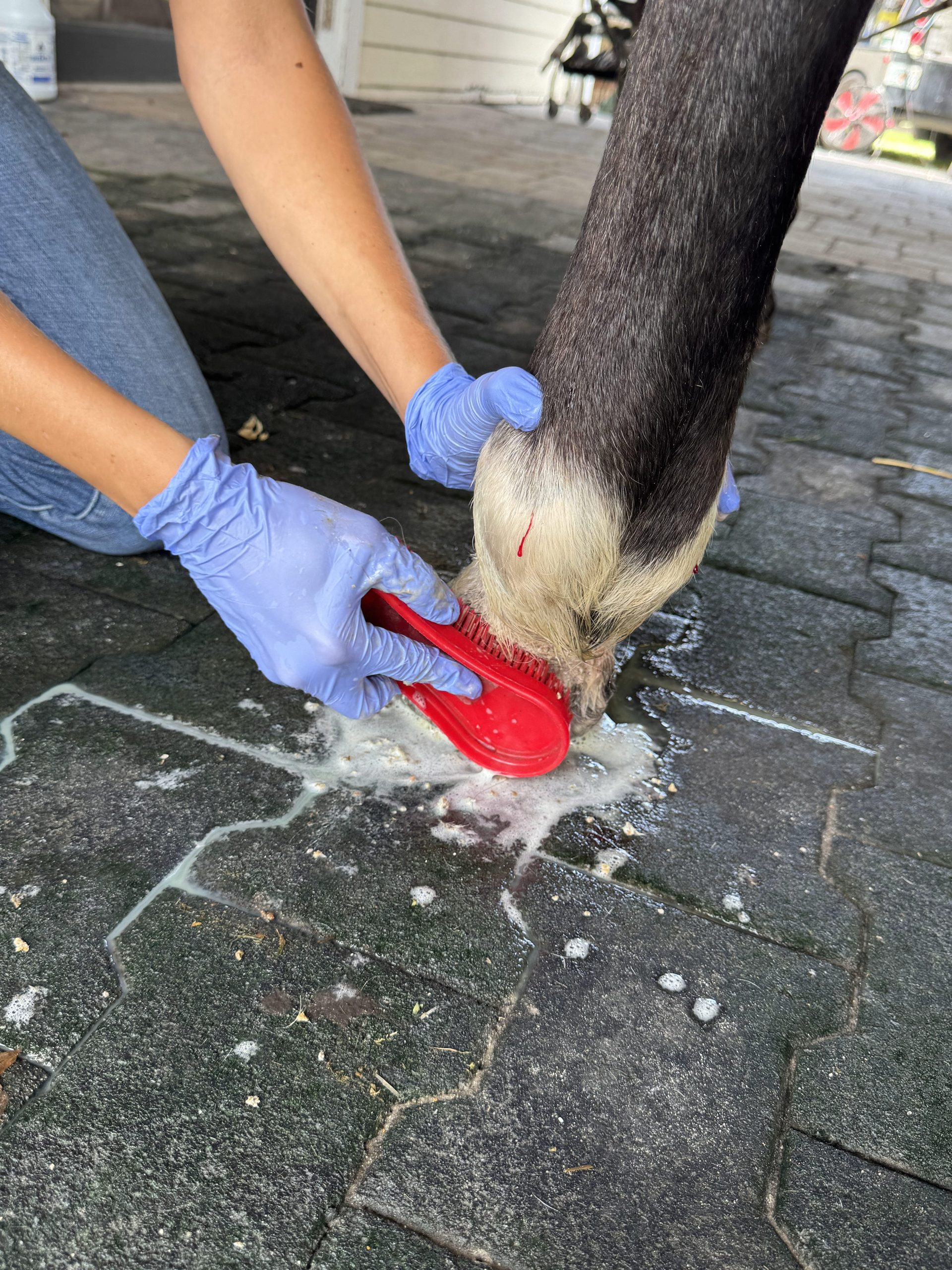
2. Dry the legs completely
If I could highlight one step, it would be this one.
Don’t wash a pastern and then leave it damp.
Hair, especially thick feathering, can trap water against the skin. After cleaning, the area should be allowed to dry thoroughly before applying whatever treatment or protection your veterinarian has recommended.
Washing isn’t necessarily the problem but leaving skin damp afterward can be. This is another reason washing more isn’t inherently better if you are unable to get the area thoroughly dry afterward.
3. Should you clip a horse with scratches?
Sometimes.
Thick hair can make it difficult to see the skin, keep the area clean, dry it completely or get a topical medication onto the actual lesion rather than the surrounding hair. Heavy feathering is also a recognized risk factor for EPD.
But running clippers across already inflamed, crusted skin can create additional trauma.
When I need to reduce heavy hair around an irritated pastern, I prefer a conservative approach: turn the clippers so the blade points downward and lightly skim away the bulk of the hair rather than trying to produce a close, show ring quality clip.
It won’t be pretty and that’s okay. It will allow the skin to dry more quickly and get topicals onto the skin, not stuck in the hair.
4. Topical treatment depends on what you’re treating
This is where the tack trunk pharmacy can get out of hand, expeditiously.
Over the years, Simon has been treated with or trialed on chlorhexidine products, povidone iodine, silver sulfadiazine, prescription combination products, topical corticosteroids, silver products, manuka honey, zinc oxide barrier creams, antibacterial/antifungal shampoos and various combinations of those products.
Some helped temporarily. Some seemed to do very little. Some were useful during one flare and less helpful during others.
That experience makes much more sense once you understand that EPD isn’t one disease.
Antibacterial, antiparasitic, anti inflammatory, barrier and other therapies aren’t interchangeable. If you’re repeatedly throwing products at a case and getting nowhere, that’s a good reason to involve your veterinarian rather than buying another tub of whatever the local tack shop has in stock.
A study of owner treatment decisions in horses with EPD also found that much treatment occurred without veterinary consultation, the authors cautioned that delayed veterinary involvement can make identifying the underlying cause more difficult.
5. What about wrapping scratches?
Here’s where my experience diverges from the simplest version of conventional advice.
Long term occlusive wrapping can absolutely create problems. Trapping moisture against already compromised skin could perpetuate the very conditions you’re trying to control.
But horses don’t live in laboratories.
An unwrapped pastern in a barn isn’t sitting on a sterile stainless steel table enjoying perfect airflow.
It’s encountering bedding, dust, soil, manure, urine soaked stall material, mud, flies, wet grass and whatever else the average horse manages to come into contact with over the course of a day.
A barrier ointment can help but a thin layer of ointment on a moving pastern doesn’t remain perfectly distributed for the next 12 to 24 hours.
For Simon, carefully managed wrapping was one of the most useful tools we ever found.
During significant flares, the system that seemed to work best was actually incredibly simple: a clean, completely dry leg, a clean gauze pad over the affected area, vet wrap, and Elastikon used to keep the bandage securely positioned. Other times, we used the same setup with a thin layer of whichever topical treatment was appropriate at the time.
This isn’t a recommendation to put every horse with scratches onto a daily bandage protocol. Improperly applied lower limb bandages can cause damage and wet or contaminated wraps defeat much of the purpose.
It is, however, a reason I don’t necessarily believe “never cover scratches because they need to breathe” should be treated as an absolute rule.
I believe the real question is what environment you’re creating against the skin and whether it’s cleaner, drier and less traumatic than the environment you’re excluding.
6. The long term management strategy that finally worked for Simon
Today Simon is 24.
After more than a decade of fighting his pasterns, our maintenance routine is surprisingly boring. (Can I get a “Hallelujah”?)
His hind legs are kept clipped fairly regularly. He wears clean Silver Whinnys socks essentially full time. When he comes in from overnight turnout, the socks come off, he’s hosed as part of his normal skin care routine and he’s allowed to dry completely before a fresh pair goes on. The used pair is washed according to the manufacturers instructions and air dried.
We own multiple pairs so we’re never tempted to put damp or dirty ones back on.
If the paddock is wet enough that the socks would become saturated and hold moisture against his skin, they come off for turnout or he doesn’t go out if conditions are genuinely muddy or rain is expected.
If I see a little irritation beginning, a light zinc-oxide barrier for a couple of days is often all we need now.
I won’t claim a pair of socks “cures scratches.”
What they appear to do extremely well for this horse is help us control the environment immediately surrounding skin that has spent years demonstrating how badly it handles environmental insult.
Simon’s case: when “scratches” becomes something much bigger
Simon is an Appendix Quarter Horse who spent much of his career as a hunter. His scratches began years ago and eventually became far more severe than the mild pastern irritation most horse owners picture when they hear the word.
Both hind legs were affected and his white hind was not consistently worse than his dark hind.
At their worst, his pasterns developed extensive crusting, broken and painful skin, heat and swelling. Occasionally he became lame.
And several times, the situation escalated into something I consider an emergency:
cellulitis.
The pattern became familiar. We’d have a few consecutive days where I couldn’t seem to get ahead of the inflammation and the pastern would look angrier despite treatment.
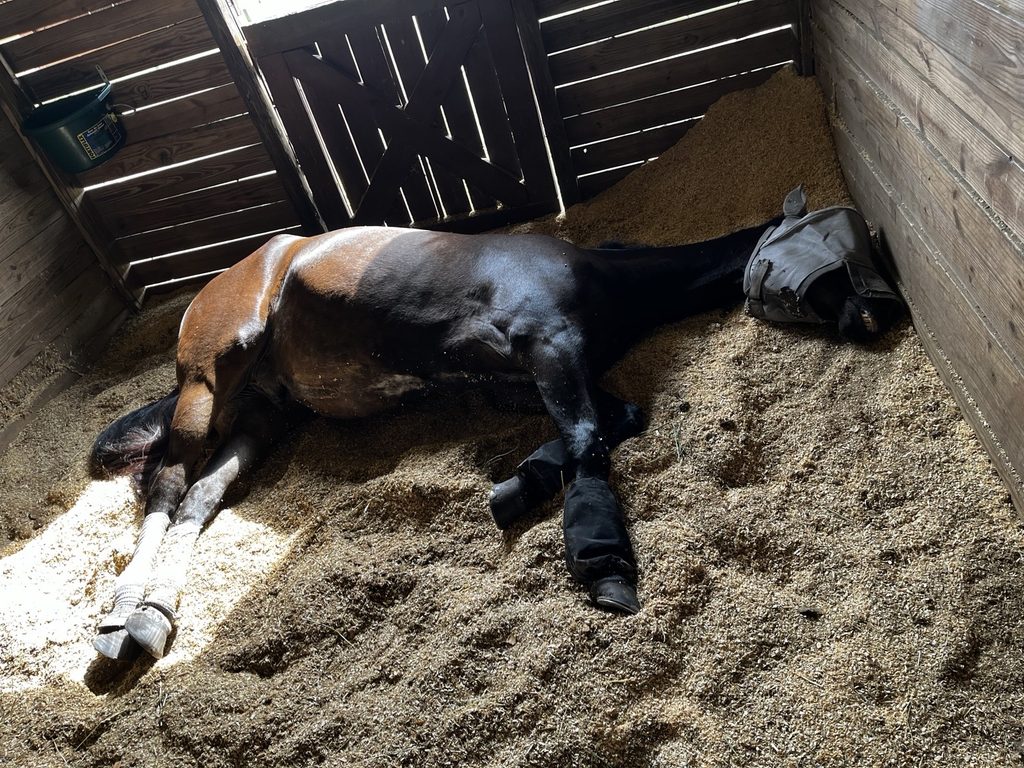
Then I’d arrive at the barn to find a dramatically swollen, hot “stovepipe” leg accompanied by lameness, fever and decreased appetite.
Each time that happened, I called a veterinarian, including the emergency veterinarian when it happened after hours or on a weekend.
Caption: Simon during one of several episodes of cellulitis secondary to severe disruption of the skin of his lower limb. Dramatic swelling, heat, lameness, fever or systemic illness warrants prompt veterinary attention.
With veterinary treatment and systemic antibiotics, Simon generally became noticeably more comfortable and the swelling and heat began improving within roughly 48 hours.
I never recommend the “wait and see” approach with that presentation.
Treatments we tried when conventional management wasn’t enough
Simon eventually became one of those horses where the treatment history sounds absurd when you read it all at once.
Over the course of a decade and a half, we changed bedding, changed turnout and tried eliminating environmental variables. We tried clipping and not clipping, wrapping and not wrapping, different soaps, shampoos and ointments, rescription topical medications, oral and injectable antibiotics when infection warranted them, systemic corticosteroids, different management environments.
Corticosteroids could dramatically quiet inflammation during a severe flare but the benefit really only existed while he was receiving them. They were a tool, not a permanent solution and aren’t something we now use, as Simon has aged and developed PPID.
We also tried regenerative/experimental approaches.
One treatment more than a decade ago involved processing material collected from Simon’s blood and administering the resulting product. I no longer have enough documentation from that treatment to responsibly tell you exactly what preparation was used, so I’m not going to pretend otherwise.
Later, Simon participated in an experimental placental patch treatment performed by a team involving human medical researchers and equine veterinarians.
For those treatments, he was sedated and local/nerve blocks were used before the affected tissue was extensively cleaned and debrided. Placental patches were then placed over the lesions and his legs were bandaged.


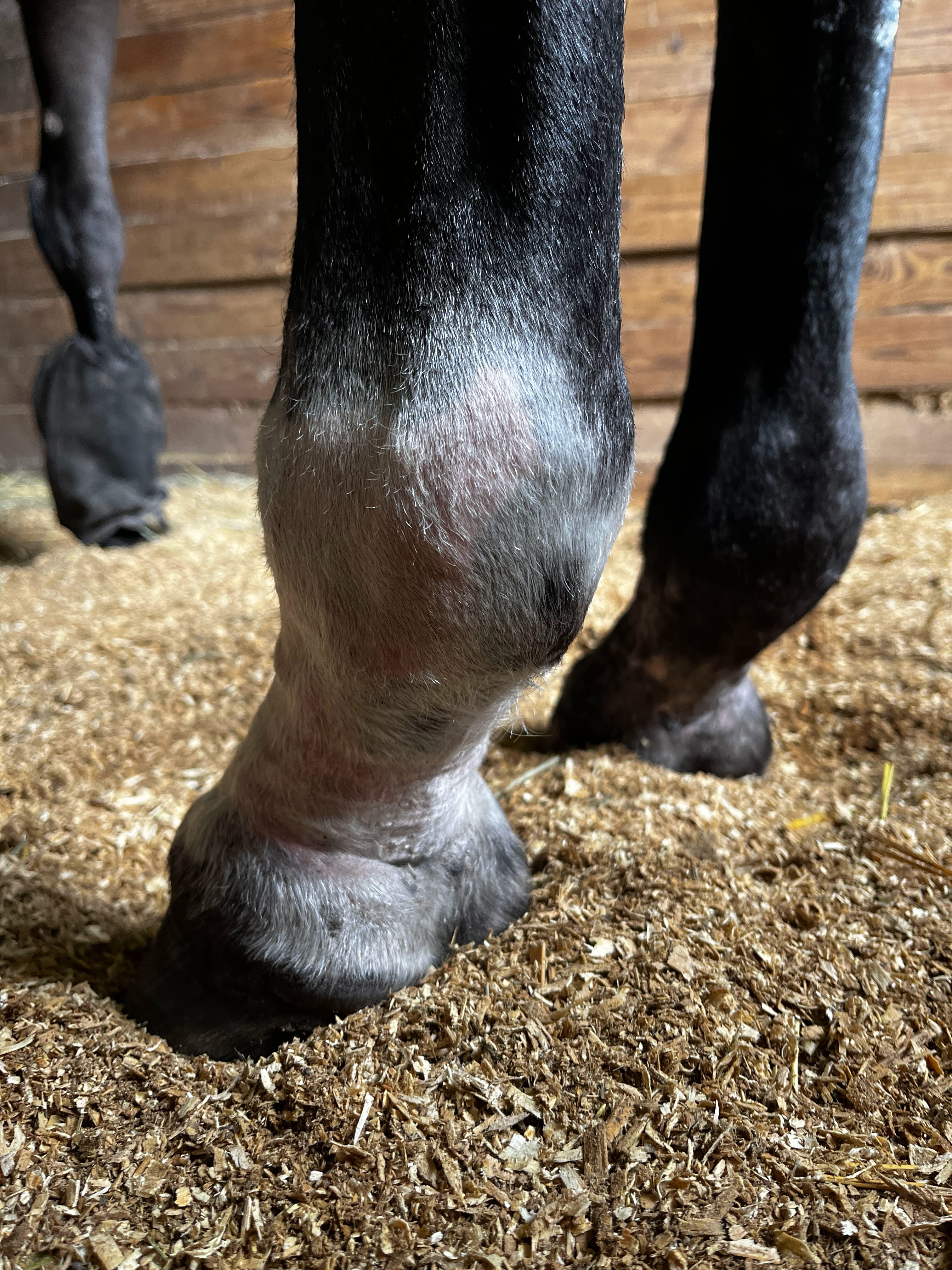
His lesions eventually healed.
But here’s the important part:
I cannot tell you that the placental patches caused the healing.
During that same period, his legs were professionally cleaned and then consistently protected under bandages for weeks. Those management changes alone could have contributed substantially.
That’s why I consider the treatment an interesting part of Simon’s medical history and not necessarily proof that placental patches cure equine pastern dermatitis.
When scratches become cellulitis
This deserves its own little section because it’s the complication I most want owners to recognize.
Inflamed or ulcerated skin means the body’s protective barrier has been disrupted or damaged. Secondary bacterial infection can occur in damaged skin and deeper infection can become much more serious.
A horse with a little crusting behind the pastern is one thing but a horse whose leg suddenly becomes dramatically swollen, hot and painful, particularly when accompanied by lameness, fever, lethargy or decreased appetite, is quite another.
Call your veterinarian.
Don’t assume you’re simply looking at “really bad scratches.”
Simon taught me how quickly the picture can change.

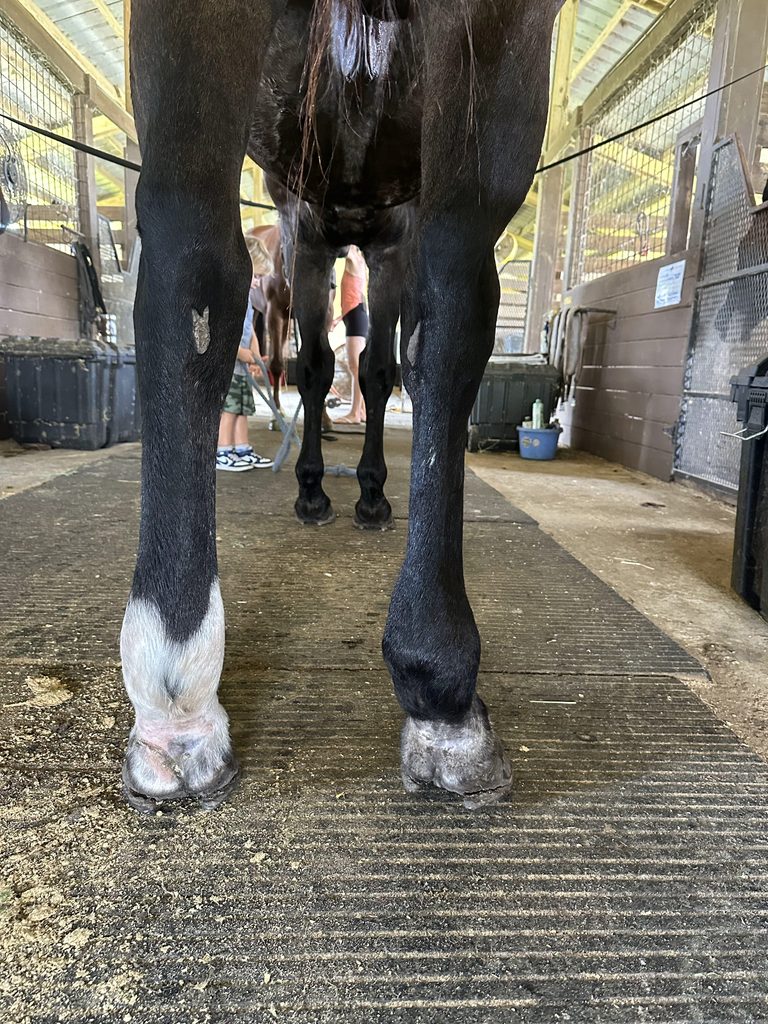
When should you call the vet for scratches?
Don’t wait for a catastrophe before involving your vet.
Veterinary attention becomes especially important when the condition is worsening, recurrent or persistent; involves significant swelling, heat, pain, discharge or extensive ulceration; causes lameness; doesn’t respond to reasonable initial management; or is accompanied by fever, lethargy or reduced appetite.
Recurrent cases may warrant investigating why the skin isn’t recovering rather than repeatedly cycling through more topical products.
And if your horse’s leg suddenly blows up like a stovepipe, that’s no longer a “which scratches cream should I order?” problem.
Can scratches be prevented?
Not every case is preventable, especially in horses with underlying predispositions but you can stack the deck in your favor.
Inspect your horses pasterns regularly. Avoid prolonged exposure to mud and chronically wet bedding where possible. Keep stalls clean and dry. If you wash legs, dry them completely. Manage heavy feathering when appropriate. Address parasites and other underlying conditions with your veterinarian. And learn what early inflammation looks like on your own horse.
For the chronically affected horse, prevention may eventually become highly individualized.
For Simon, that means clean dry skin, controlling moisture exposure, maintaining manageable hair length and using clean protective socks.
Each horses treatment plan likely looks slightly different depending on their age, breed, climate, lifestyle, medical history and a whole host of other factors. It’s one more great reason to have a great working relationship with your veterinarian.
The biggest thing I’ve learned about scratches
For a mild case, “keep it clean and dry” may be exactly the advice you need.
For a horse like Simon, that sentence barely begins to describe the problem.
Equine pastern dermatitis isn’t a single infection with a single universally effective treatment. Veterinary research describes it as a multifactorial syndrome and even the scientific literature acknowledges significant gaps in our understanding of its risk factors and treatment.
After more than a decade of managing one exceptionally difficult case and caring for many much simpler ones, my biggest lesson has been this:
Protect the skin barrier. Pay attention to the environment. Don’t create additional trauma in the name of cleaning. And when a case isn’t behaving like ordinary scratches, stop treating it like ordinary scratches.
Sometimes the best management plan isn’t the neatest one on paper, it’s the one that keeps the horse standing in front of you comfortable.
A note from The Bridle House
This article is educational and is not a substitute for diagnosis or treatment by your veterinarian. Equine pastern dermatitis can have multiple underlying causes and medications, including antibiotics and corticosteroids, should only be used under veterinary guidance. Limb swelling, significant heat or pain, lameness, fever, lethargy or loss of appetite warrants prompt veterinary attention.
Sources & Further Reading
Research and veterinary resources used in the preparation of this article include:
- Equine pastern dermatitis: A review of the literature — Journal of the American Veterinary Medical Association, 2023
- Pastern Dermatitis (Scratches) — UC Davis Center for Equine Health
- Scratches: A Skin Problem in Horses — University of Minnesota Extension
- Owner reported clinical signs and treatment decisions in equine pastern dermatitis — Schweizer Archiv fur Tierheilkunde, 2022
- Dermatitis and Dermatologic Problems of Horses — MSD Veterinary Manual